
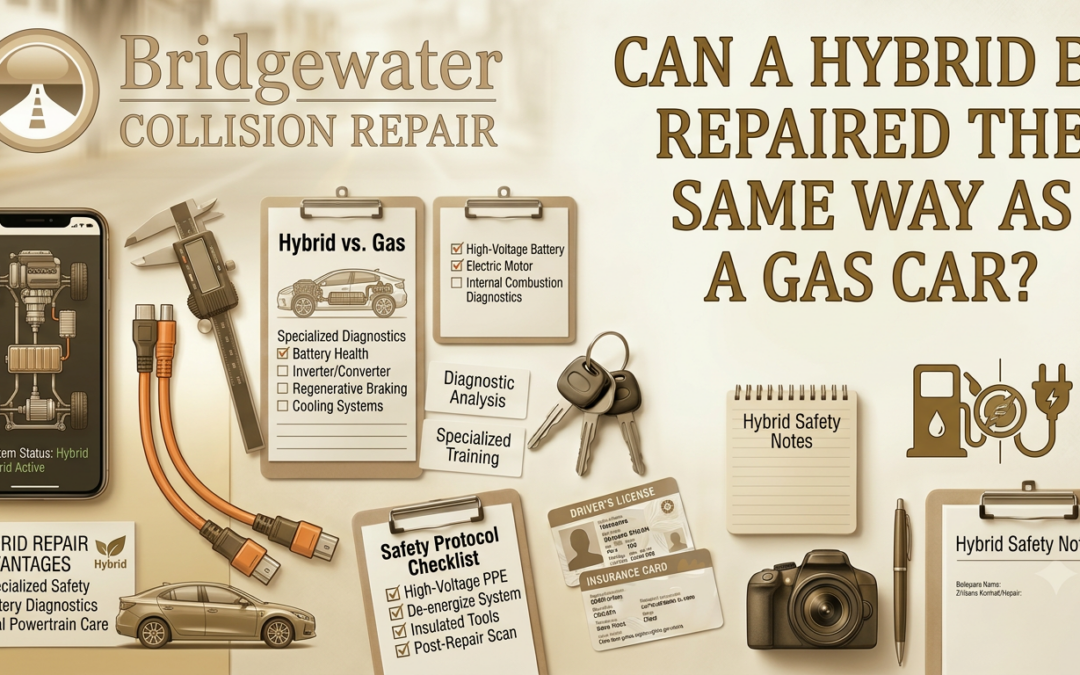
Hybrid vehicles have become common enough on NJ roads that many drivers own one without thinking much about what is under the hood beyond the fuel savings. When a hybrid is in a collision, however, the repair process raises questions that do not come up with a conventional gas-powered vehicle. The bodywork and frame repair are largely comparable. What differs is the hybrid’s electrical system, which introduces components, voltage levels, and shutdown procedures that require specific training and equipment to handle properly.
This article explains where hybrid repair aligns with conventional repair, where it diverges, and what to look for when selecting a facility after a hybrid is involved in a collision.
How Are Hybrids Structurally Similar to Gas Vehicles?
Most hybrid passenger vehicles use the same fundamental structural platforms as their gas-powered counterparts. The unibody construction, sheet metal panels, bumper assemblies, and crumple zone engineering follow the same principles. A Toyota Camry Hybrid and a standard Camry, for example, share body structure, door panels, quarter panels, and rooflines. Frame straightening, panel replacement, paint matching, and refinishing procedures are virtually identical between the two.
This means that most of what a collision repair facility does day-to-day applies equally to a hybrid. The repair differences are concentrated in the vehicle’s high-voltage system and the components associated with it, not in the body or structure itself. A facility that is otherwise qualified and follows OEM repair procedures will handle the structural and cosmetic portions of a hybrid repair the same way it would any comparable vehicle in that manufacturer’s lineup.
What Is Different About the High-Voltage System in a Hybrid?
Hybrids carry a high-voltage battery pack in addition to a conventional 12-volt battery. The voltage level varies by manufacturer and system design, but most full hybrids operate at voltages that require the same cautious handling as plug-in hybrid and fully electric systems, just at somewhat lower levels. The high-voltage system powers the electric motor, charges through regenerative braking, and in plug-in hybrids can also be charged externally.
Before any collision repair work begins, the high-voltage system must be de-energized following the manufacturer’s procedure for that specific vehicle. This is not the same as switching the car off. It involves disconnecting the 12-volt auxiliary battery to disable the high-voltage system’s control circuits, then confirming that the system is isolated before proceeding. The waiting period for capacitors to discharge also applies to hybrids, though the duration varies by system. Technicians who handle high-voltage systems must be trained specifically for this work. A facility that treats a hybrid exactly like a gas vehicle, without this de-energization step, is not following safe or correct repair practice.
Are Hybrid Battery Packs in the Same Location as EV Batteries?
Not necessarily, and this matters for collision repair. Unlike many fully electric vehicles where a large battery pack occupies the full floor of the vehicle, hybrid battery packs vary in size and placement depending on the powertrain design. Some are located under the rear seat, some in the trunk, and others under the cargo area. In most passenger hybrids, the battery pack is smaller than an EV’s and positioned to minimize intrusion into cargo or passenger space.
The placement determines which repairs require particular care around the battery. A rear collision on a hybrid where the battery is located in the trunk or beneath the rear seat requires evaluation of whether the battery enclosure was affected. A frontal impact on the same vehicle may carry fewer battery-specific concerns, though the overall high-voltage system still must be properly managed before structural work begins in any impact zone. OEM repair documentation specifies what applies to each model and impact configuration.
Do Hybrids Require ADAS Recalibration After a Collision?
Yes, and in many cases the ADAS requirements for a hybrid are identical to those for the equivalent gas vehicle in the same manufacturer’s lineup. Forward collision warning, lane departure systems, adaptive cruise control, and parking sensors are features of the vehicle platform, not the powertrain. If a collision affects components that house or mount these sensors, such as the windshield, front bumper, rear fascia, or side mirrors, recalibration is required regardless of whether the vehicle is a hybrid or a gas model.
Some hybrid-specific systems do interact with ADAS components, particularly when regenerative braking is part of the vehicle’s collision mitigation system. In these cases, proper post-repair calibration ensures that the hybrid’s integrated braking behavior functions as designed. A post-scan after repairs, using the manufacturer’s diagnostic software, confirms that all systems including both the conventional ADAS features and the hybrid powertrain integration are operating correctly.
What Should You Ask a Shop Before Leaving a Hybrid for Repair?
Ask directly whether the facility has trained technicians for high-voltage system management on your specific vehicle. OEM certification programs often include training requirements for hybrid and EV repair as part of the certification criteria. Ask whether the facility will perform a pre-scan before repairs begin and a post-scan after completion. Ask whether they can provide documentation of the calibrations performed on any ADAS components that were affected.
For a deeper look at how fully electric vehicle repairs differ and what the high-voltage system involves at its most complex, the post on Electric Vehicle Collision Repair covers that topic in detail. The article on Comparing Certifications: I-CAR, OEM, EV, and Aluminum Training Explained explains what the relevant training credentials mean in practical terms.
Schedule an Assessment at Bridgewater Collision Repair
If your hybrid vehicle has been in a collision, our team can walk you through what the repair process involves before any work begins. We follow manufacturer repair procedures and document our work throughout the process. Contact us to schedule an assessment at either our Bridgewater or Glen Gardner/Clinton location.