
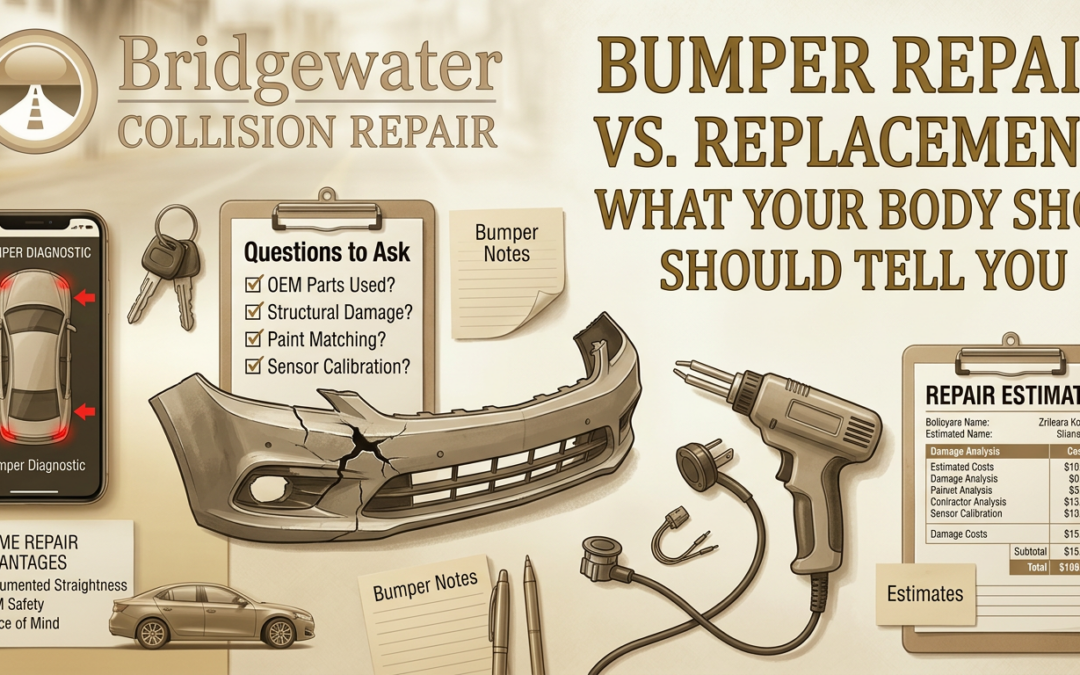
Bumper damage is one of the most common outcomes of a collision, and one of the most frequently misunderstood. The decision to repair or replace a bumper cover is not always straightforward, and several factors beyond the visible surface damage determine which approach is appropriate. What looks like a simple scuff or crack may involve components underneath that affect both safety and sensor function. And some damage that looks significant may be repairable without replacement. A qualified body shop should be able to explain their recommendation clearly and walk you through the reasoning.
What Does a Modern Bumper System Actually Consist Of?
The term “bumper” in everyday use usually refers to the bumper cover, which is the painted plastic fascia that gives the vehicle’s front or rear its finished appearance. But the full bumper assembly involves several components that work together. Behind the cover sits an energy absorber, typically a foam or plastic block designed to compress in low-speed impacts. Behind that is the bumper reinforcement bar, a structural metal component that transfers impact forces to the vehicle’s frame rails. Some vehicles also include a bracket or isolator between the reinforcement bar and the frame.
Modern bumpers also house a growing number of sensors. Parking sensors, backup cameras, radar units for adaptive cruise control and automatic emergency braking, and in some vehicles, the front-facing camera for lane keeping systems are all integrated into or behind the bumper fascia. Damage that affects any of these components requires more than cosmetic repair to restore the vehicle to proper operating condition.
When Can a Bumper Cover Be Repaired Rather Than Replaced?
Bumper cover repair is appropriate when the damage is limited to the outer surface and the cover retains its structural integrity. Minor scrapes, shallow surface cracks, and small gouges that do not penetrate through the material can often be repaired with plastic welding or flexible filler, properly primed, and refinished to match. Repair is generally appropriate when the bumper cover is not cracked through, is not missing sections, has not been pushed out of shape in a way that prevents it from seating properly, and does not have damage in areas where sensors are mounted.
The finish quality of a repaired bumper cover, when done correctly, is comparable to a replacement. The key factor is whether the cover itself is still sound as a substrate. A cover that has been pushed into the reinforcement bar during impact may have hairline cracks or stress marks that are not fully visible at first inspection but will read through the paint finish after refinishing. A thorough inspection before making a repair-versus-replace decision accounts for this.
When Should a Bumper Cover Be Replaced?
Replacement is the right choice when the cover has been cracked through, when it has large missing sections, when the mounting tabs or clips have broken in a way that prevents proper fitment, or when it has been deformed in a way that altered its shape. A cover that fits improperly after repair will show panel gap irregularities and may not seal correctly around adjacent components.
Replacement is also indicated when the damage is in an area that houses sensors, because the repair process in those areas must preserve precise dimensional tolerances. A sensor housing that has been stressed or deformed, even subtly, may not hold its calibrated position correctly. In these cases, replacing the cover with an OEM or approved part and recalibrating the sensors provides a more reliable outcome than repairing a damaged cover and hoping the sensor position is still accurate.
What About the Reinforcement Bar and Energy Absorber?
These components often need to be inspected after a collision even when the bumper cover itself looks minimally damaged. Low-speed impacts are exactly what energy absorbers are designed to handle, and a foam energy absorber that has compressed significantly may not recover fully. Its function in a subsequent impact is compromised even if it looks intact from the outside. Similarly, a reinforcement bar that sustained a direct impact may have deformed slightly without cracking visibly.
The reinforcement bar transfers impact forces to the vehicle’s frame rails. If it has been deformed, it may not distribute forces correctly in a future impact, or it may not be positioned to engage the crash structure the way it is designed to. Inspecting these components requires removing the bumper cover, which is part of a thorough post-collision assessment regardless of how the outer surface looks. The post on Hidden Damage After an Accident covers how technicians identify damage that isn’t visible from outside the vehicle.
What Happens to Bumper Sensors When a Bumper Is Repaired or Replaced?
Any repair or replacement that affects components in the sensor zone requires recalibration after the work is complete. This is true whether the sensor itself was directly damaged or not. A bumper replacement, for example, changes the position of the forward radar unit by even a fraction of an inch if the new component is not seated to the same position as the original. Static and dynamic calibration procedures restore the sensor’s functional relationship to the vehicle’s other systems.
Skipping calibration after bumper work on a vehicle with ADAS features is one of the more common reasons driver assistance systems perform incorrectly after a repair that otherwise appeared to go well. A post-scan after the repair confirms whether any fault codes are stored related to sensor systems, which helps identify calibration issues before the vehicle leaves the shop. For more on what calibration involves and why it matters, the articles on Why Do ADAS Calibrations Get Missed and Why ADAS Calibration Is So Important cover the topic in depth.
Schedule an Assessment at Bridgewater Collision Repair
If your vehicle’s bumper was damaged in a collision, our team can assess what the repair involves and explain the recommendation before any work begins. We inspect the full bumper assembly, including the reinforcement bar, energy absorber, and sensor components, not just the outer cover. Contact us to schedule an assessment at either our Bridgewater or Glen Gardner/Clinton location.