
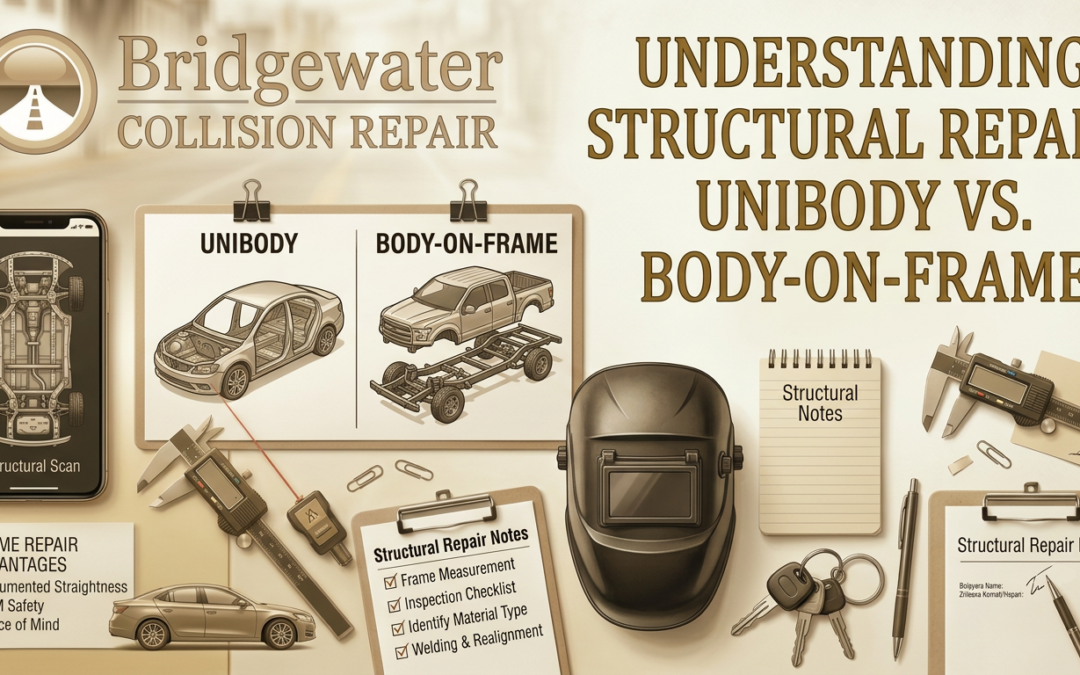
When a vehicle sustains structural damage in a collision, the repair approach depends heavily on how the vehicle was built. The two dominant structural designs for passenger vehicles are unibody construction and body-on-frame construction, and they respond to collision forces differently, fail differently, and require different repair approaches. Most passenger cars and crossovers use unibody construction. Most full-size trucks and traditional SUVs use body-on-frame construction. Understanding the difference helps explain why a structural repair on a pickup truck and a structural repair on a sedan involve different processes, even when the visible damage looks similar.
What Is Unibody Construction?
In a unibody vehicle, the body and the frame are integrated into a single structure. There is no separate chassis beneath the body. Instead, the floor pan, firewall, roof, pillars, rocker panels, and frame rails are all stamped and welded together into one continuous unit. This assembly provides the vehicle’s structural rigidity, supports the suspension and drivetrain, and forms the safety cage around occupants.
Unibody construction offers weight and handling advantages over body-on-frame designs, which is why virtually all modern passenger cars, minivans, crossovers, and many SUVs use it. It also allows manufacturers to engineer precise crumple zones, sections of the structure designed to deform in a controlled way during a collision to absorb energy before it reaches the occupant compartment. When these engineered crumple zones are deformed in a collision, restoring the vehicle’s structural geometry requires measuring the entire vehicle against manufacturer specifications, not just the area that was visibly damaged.
What Is Body-on-Frame Construction?
In a body-on-frame vehicle, the body is a separate structure mounted on top of a ladder-style chassis frame. The frame, not the body, carries the vehicle’s structural loads. The suspension is mounted to the frame, the drivetrain is supported by the frame, and the body attaches to the frame through rubber mounts that isolate vibration and noise.
Full-size pickup trucks such as the Ford F-150, Chevrolet Silverado, and Ram 1500 use body-on-frame construction, as do body-on-frame SUVs including the Ford Expedition, Chevrolet Tahoe, and Toyota 4Runner. This construction method is favored for towing and off-road applications because the separate frame provides greater torsional rigidity under load. In a collision, the frame and the body can be damaged independently, which affects how a repair assessment is structured and what components need to be evaluated separately.
How Does the Construction Type Affect Collision Repair?
For unibody vehicles, structural repair focuses on restoring the integrated structure to the manufacturer’s dimensional specifications. Computerized measurement systems take readings at multiple points across the vehicle and compare them against the manufacturer’s published data for that model. Any deviation from specification indicates deformation that must be addressed. Because the body and frame are one unit, damage in one area can transmit force and cause deformation in areas far from the impact point.
For body-on-frame vehicles, the frame and the body are evaluated separately. A collision may damage the body panels and components without affecting the frame at all, or it may deform the frame while leaving the body relatively intact. Frame damage on a body-on-frame vehicle involves straightening the ladder chassis itself using hydraulic equipment and computerized measurement, which is a different process from unibody structural repair. In severe cases, frame sections may need to be replaced. OEM documentation specifies approved repair procedures for each frame design, including which sections can be sectioned and which must be replaced as a unit.
Why Does This Matter for How Your Repair Is Assessed?
Understanding which construction type your vehicle uses helps set accurate expectations for the repair process. A unibody vehicle that appears to have localized damage in one corner may require full-vehicle structural measurement because force transmission through the integrated structure can cause remote deformation. A body-on-frame vehicle with visible body damage may have a frame that is entirely unaffected, or the frame inspection may reveal damage that the body damage alone did not suggest.
Either way, a thorough structural assessment requires more than a visual inspection of the damaged area. For unibody vehicles, computerized measurement is the standard. For body-on-frame vehicles, a combination of frame measurement and visual inspection of the frame rails, cross members, and mounting points provides a complete picture. The article on Hidden Damage After an Accident explains how post-collision inspections frequently reveal damage that was not apparent from the surface, regardless of construction type.
What Are the Repair Standards for Each Type?
Both construction types require adherence to OEM repair documentation. Manufacturers publish procedures that specify approved repair methods, sectioning locations, welding requirements, and material handling for high-strength steel and aluminum components. These procedures differ by construction type and by model.
High-strength steel, which is common in both unibody and body-on-frame structural components, requires specific welding processes to maintain its properties. Standard welding can alter the material properties of high-strength steel and reduce its effectiveness in a subsequent impact. OEM-certified shops work from manufacturer repair documentation and use the processes that preserve those material properties. The article on Understanding Auto Body Frame Restoration explains the measurement and straightening process in more depth for both vehicle types.
Schedule an Assessment at Bridgewater Collision Repair
Whether your vehicle uses unibody or body-on-frame construction, our team can assess the structural damage and explain what the repair involves before work begins. We use computerized measurement systems and follow OEM repair procedures on every structural job. Contact us to schedule an assessment at either our Bridgewater or Glen Gardner/Clinton location.