
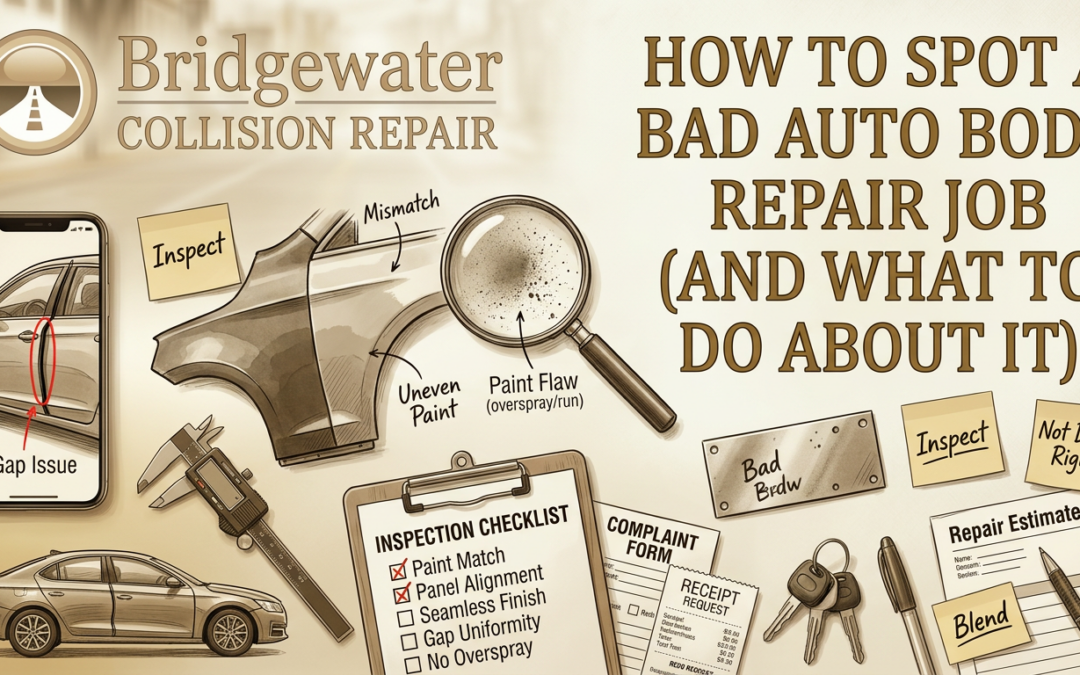
Picking up your vehicle after collision repair should feel straightforward. You drop off a damaged car, and you pick up one that looks and drives the way it did before the accident. When that does not happen, it can be difficult to know exactly what you are seeing and what your options are. Drivers have the right to inspect repair work before accepting delivery, and they have recourse under New Jersey law when the work does not meet a reasonable standard.
This article covers what a properly repaired vehicle should look like, the specific things to evaluate when you pick up your car, and the steps available to you in New Jersey if the repair falls short.
What Should a Properly Repaired Vehicle Look Like?
Setting a clear standard helps you evaluate what you are actually looking at. A properly repaired vehicle should have panel gaps that are consistent and even around all repaired areas. Doors, hoods, trunk lids, and fenders should align with surrounding panels at the same spacing and angle as they did before the accident. Body lines, which are the character lines that run across panels on modern vehicles, should flow continuously without offsets or steps where repaired panels meet original ones.
The paint finish should have consistent color, sheen, and texture across repaired and original panels. There should be no overspray on adjacent trim, glass, rubber seals, or emblems. The vehicle should drive the same as it did before the repair, with no new pulling, vibration, or unusual sounds. And for any vehicle where sensors or cameras were part of the repaired area, the relevant driver assistance features should function correctly.
Paint and Finish Red Flags
Paint defects are among the more visible indicators of a repair that was not completed to standard. Runs and sags occur when paint is applied too heavily or the vehicle is moved before the paint has set properly. They appear as drips or elongated streaks in the finish and should not be present in a finished repair. Orange peel texture, which resembles the surface of an orange, is a normal characteristic of some spray finishes, but it should be consistent with the original panels. A repaired panel with noticeably more orange peel than the surrounding factory finish is a sign that the refinishing was not brought to the same level as the original.
Overspray is another clear indicator. It appears as a fine haze of paint particles on trim pieces, glass, rubber seals, door jambs, or areas adjacent to the repaired panels. A shop that properly masks the vehicle before painting should not leave overspray on any surface. Color mismatch between the repaired panel and adjacent panels, particularly when viewed at an angle in natural daylight, suggests the matching process was not completed carefully. Customers who’ve worked with Bridgewater Collision Repair have noted that their vehicles looked as good as or better than before the accident, including one driver who said the car was detailed inside and out and looked better than it had pre-repair.
Panel and Alignment Red Flags
Evaluate panel gaps methodically by walking around the entire vehicle and comparing the spacing between panels on the repaired side against the corresponding gaps on the opposite side. The gaps should be symmetrical. An uneven gap, one that is wider at the top than the bottom, or wider at one end than the other, can indicate that a panel was not properly positioned or that underlying structural geometry was not fully corrected.
Trim pieces that sit proud of the panel surface, clips that appear strained or misaligned, and emblems that are not properly centered are signs that reassembly was rushed. These are not just cosmetic concerns. They can indicate that the panel itself is not properly positioned, which affects both appearance and the structural function of the panel in a subsequent impact.
Mechanical and Safety Red Flags
New warning lights that were not illuminated before you dropped the vehicle off are a significant concern. A check engine light, a stability control warning, or an ADAS-related indicator that appears after repair suggests that a sensor was not reconnected, was damaged during repair, or was not properly recalibrated. Ask the shop to explain any new indicator before accepting the vehicle.
Handling changes, vibration through the steering wheel or seat, or sounds you did not hear before the repair are also worth raising. Some of these may have simple explanations, such as a loose trim panel. Others may indicate that alignment, suspension, or structural work was not completed correctly. A post-scan of the vehicle’s onboard systems can identify stored fault codes that a visual inspection would not reveal. For more on what pre-scans and post-scans detect and why they matter, see the blog post on What Happens If Your Car Isn’t Repaired to OEM Specifications.
What Are Your Options If the Repair Is Substandard?
The first step is to return to the shop with your specific concerns documented in writing. Note each item with photographs before leaving the facility after pickup. A legitimate repair shop will address warranty concerns on their work. Keep communication in writing where possible so there is a clear record of what was reported and when.
If the shop performed the repair as an insurer’s preferred facility and is not addressing your concerns, you can escalate through your insurer’s claims process. The insurer has an obligation to ensure that the repair meets a reasonable standard, and a shop operating within their preferred network is accountable to that standard. If the concern involves the insurer’s own handling of the situation, the NJ DOBI Office of the Insurance Ombudsman handles consumer complaints related to claim disputes. The New Jersey Division of Consumer Affairs also accepts complaints against licensed auto body shops for workmanship issues.
How Do You Protect Yourself Before Work Begins?
The best protection against substandard repair is selecting the right facility before the work starts. Ask whether the shop follows OEM repair procedures, what parts they use, whether they perform a post-scan after repairs, and whether they can provide calibration documentation for any sensor work. A shop that answers these questions readily and specifically is one that understands what quality repair involves. For guidance on selecting a facility, How to Choose a Body Shop You Can Trust covers the evaluation process in detail.
Schedule an Assessment at Bridgewater Collision Repair
If you have concerns about the quality of a previous repair or want to confirm that upcoming work will be completed to manufacturer standards, our team can help. We document our work thoroughly and stand behind the repairs we perform. Contact us to schedule an assessment at either our Bridgewater or Glen Gardner/Clinton location.