
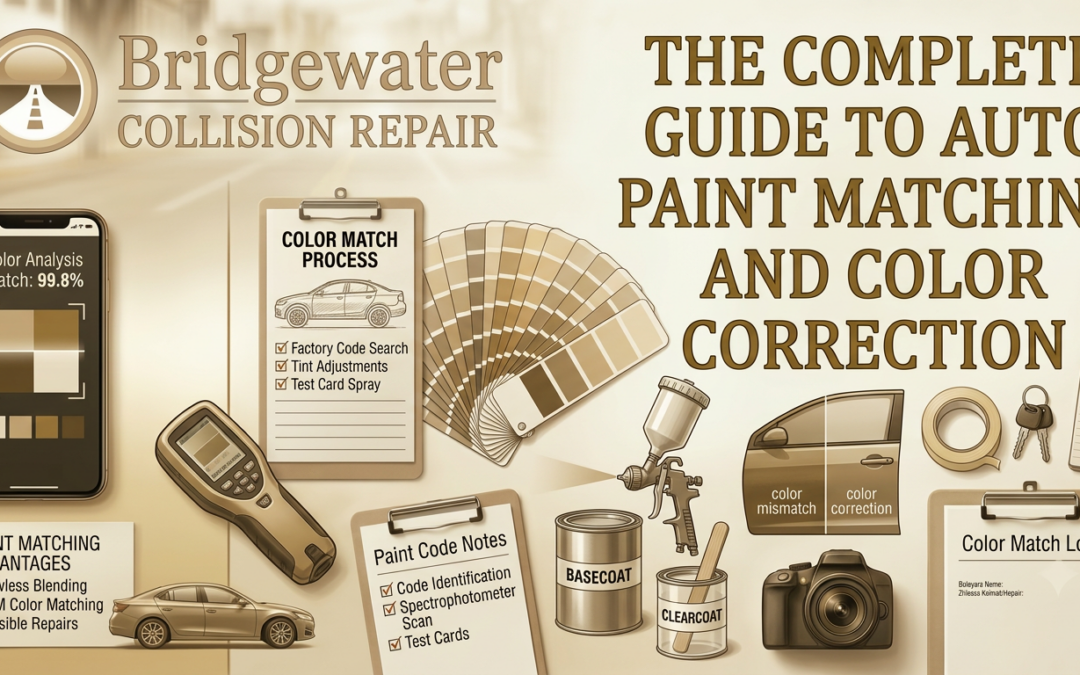
Two panels on the same vehicle can share the same paint code and still look noticeably different. This is one of the more common concerns drivers have after collision repair, and it is a reasonable one. Auto paint matching is a technical process that involves far more than selecting a code from a database and applying it. Understanding how it works helps you evaluate the quality of a repair and ask the right questions before approving the work.
This guide covers why paint codes alone are not sufficient, what the matching process involves, and how to assess the result before accepting delivery of your vehicle.
Why Don’t Paint Codes Guarantee a Perfect Match?
Every vehicle leaves the factory with a specific paint formula identified by a color code. That code is a starting point, not a final answer. Several factors cause the same code to look different on a repaired panel compared to the original finish. UV exposure gradually shifts the color of paint over time, lightening some pigments and darkening others in ways that vary by how much sun exposure the vehicle has received. Factory application tolerances also mean that two vehicles with the same code may have left the production line with slightly different hues.
Beyond fade and factory variation, paint manufacturers release formula adjustments over time to account for how commonly a color trends in the field. A formula that was accurate three years ago may have been refined to better match aged vehicles of that color. Technicians who stay current with these formula revisions are better positioned to achieve a close match on a vehicle that has some miles and sun exposure on it.
What Is the Color Matching Process?
Professional color matching begins with measurement, not assumption. A spectrophotometer reads the existing paint on the vehicle and provides a precise spectral profile of the color. This profile is then compared to the paint manufacturer’s formula library to find the closest starting formula. From there, a technician may adjust the formula through tinting, mixing small quantities of different pigments to shift the hue, value, or chroma until it aligns with the spectrophotometer reading.
A spray-out card or test panel is then created using the adjusted formula. This is a small application of the refined color sprayed onto a surface and evaluated under multiple light sources, including natural daylight, fluorescent shop lighting, and incandescent light. Colors that appear identical under one light source can diverge under another. Evaluating the spray-out under different conditions before committing to the full panel application is a standard step in a careful matching process, and it is one that separates a methodical approach from a rushed one.
How Does Paint Application Affect the Final Result?
Even a well-matched formula can produce an inconsistent result if the application process is not controlled properly. Film thickness affects how a color reads visually. A layer that is applied too thickly or too thinly shifts the appearance of the color and the depth of the finish. Spray pressure, distance from the panel, and temperature all influence how the paint atomizes and lays onto the surface.
Flash time, which is the period between coats when solvent evaporates from the previous layer, must be followed carefully. Trapping solvents under a subsequent coat leads to surface defects and affects both the appearance and the durability of the finish. Clear coat application introduces another variable, as the thickness and sheen of the clear coat affects how the color beneath reads in different lighting. A shop with a controlled spray environment and trained refinishing technicians manages these variables systematically rather than by eye alone.
What Is Panel Blending and When Is It Used?
Panel blending is a technique used to avoid a visible boundary between a newly painted panel and the adjacent original panels. Even when a formula matches closely, there can be a perceptible difference at the panel edge, particularly in metallic or pearl finishes where the angle and size of metallic flakes or mica particles affect how the finish looks from different viewing angles.
Blending involves feathering the new paint into the adjacent panel so the transition is gradual rather than abrupt. This does not mean repainting the entire car. It means extending the paint application a controlled distance into the neighboring panel to eliminate a visible seam. Insurance coverage for blending depends on the policy and the insurer, and it is a standard discussion between the repair facility and the adjuster when blending is part of a quality repair. Customers who’ve worked with Bridgewater Collision Repair have noted that the team restored their vehicles to pre-accident condition, including on repairs where paint finish was a central concern.
How Do You Evaluate the Paint Match Before You Leave?
When you pick up your vehicle, evaluate the paint in multiple lighting conditions before accepting the repair. Shop lighting is typically fluorescent, which is not the most revealing environment for evaluating a color match. If possible, move the vehicle outside and look at the repaired panel alongside the adjacent original panels in natural daylight. View from multiple angles, including a shallower angle that highlights metallic or pearl finishes.
Look for consistent sheen across panels. Orange peel texture, which looks like the skin of an orange, should be similar across the repaired area and the surrounding original finish. Any runs, drips, or sags in the clear coat are defects that should be addressed before you accept the vehicle. A mismatch in sheen level between the repaired panel and adjacent panels, even if the color is close, is worth raising with the shop before leaving. A qualified facility will stand behind the quality of its refinishing work and address any concerns before delivery is finalized.
Schedule an Assessment at Bridgewater Collision Repair
If you have concerns about paint matching on a previous repair, or want to discuss the refinishing process for upcoming work on your vehicle, our team can explain the approach before any work begins. Contact us to schedule an assessment at either our Bridgewater or Glen Gardner/Clinton location.