
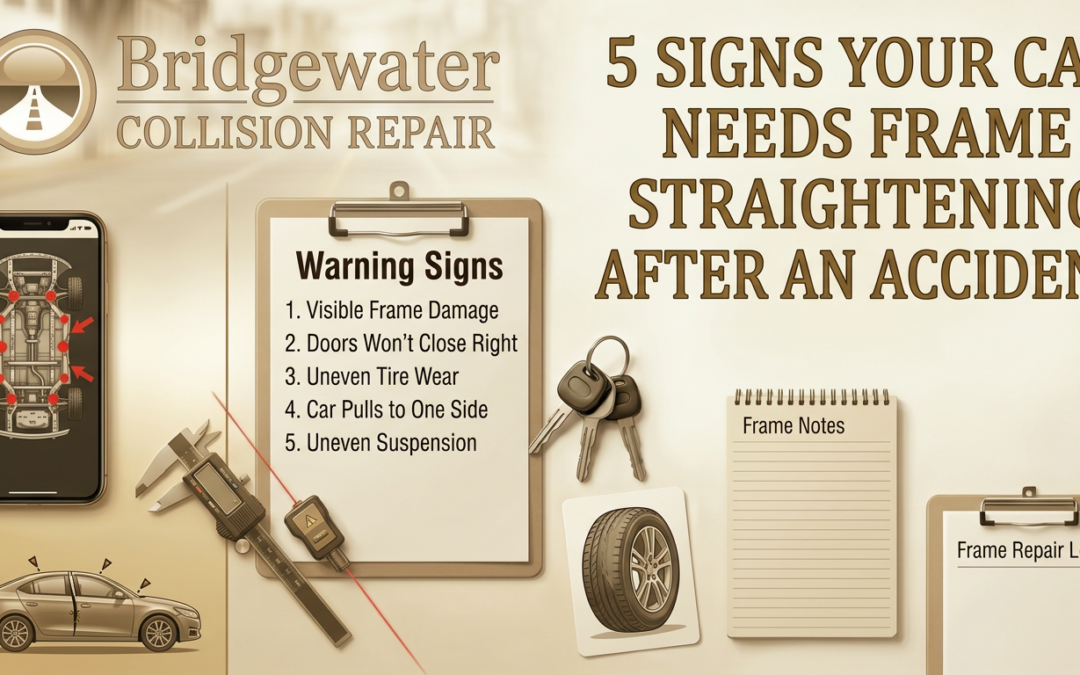
Frame damage does not always announce itself immediately after a collision. A vehicle can drive, steer, and appear normal in the days following an accident while carrying structural deformation that affects its safety performance and gradually causes other problems. Some symptoms show up right away, while others develop over the first weeks of driving as components settle into a compromised position or begin to wear unevenly under misaligned load.
Knowing what to watch for helps you identify when a professional structural inspection is warranted. Here are five signs that frame straightening may be needed after a collision.
Sign 1: The Vehicle Pulls to One Side
A consistent pull to one side on a straight, level road is one of the more common indicators of frame or alignment problems after a collision. Some pull can result from road crown, which is the slight slope built into roads for drainage, but a persistent pull that repeats regardless of road surface is more significant. If you relax your hands on the steering wheel while traveling in a straight line and the car tracks consistently to the left or right, that is worth investigating.
The distinction between a frame-related pull and a simple alignment adjustment is that alignment settings themselves can be thrown off by frame deformation. If a technician adjusts alignment angles but the vehicle still pulls, or if the alignment specifications cannot be reached within normal adjustment range, the underlying frame geometry may be the reason. An alignment check is a reasonable first step, but a facility with frame measurement capability can determine whether the alignment problem has a structural cause.
Sign 2: Unusual or Uneven Tire Wear After the Accident
Tire wear patterns develop over time, so this symptom may not be visible immediately after a collision. If you notice the tires wearing faster on one edge than the other, or wearing unevenly between the front and rear, this can indicate that the wheels are no longer rolling at the angles the vehicle was designed to maintain. Frame misalignment causes wheel angles that place abnormal side loads on the tire, producing accelerated wear in a specific pattern.
Feathering, where the tread blocks develop a sawtooth pattern, and cupping, where the tread wears in a scalloped pattern, are both associated with alignment and suspension problems that can have structural roots. If tire wear that was not present before the accident becomes noticeable within the first few months after a collision, a structural inspection is a reasonable next step.
Sign 3: Doors, Hood, or Trunk Don’t Align Properly
Body panel gaps are a visible indicator of the vehicle’s structural geometry. Doors, hoods, and trunk lids are fitted to precise tolerances at the factory. When the frame shifts, the body openings shift with it, causing gaps to become uneven. A door that suddenly requires more effort to close, a hood that sits higher on one side than the other, or a trunk lid that no longer aligns with the surrounding body lines are all worth noting after a collision.
These symptoms may appear immediately after the accident or develop gradually as the structure settles. In some cases, a driver notices that a door is harder to close in cold weather, when the metal contracts slightly, but fine in warmer conditions. This can indicate that the gap is on the edge of acceptable and that a structural measurement would clarify whether it is within specification.
Sign 4: The Car Handles Differently in Corners
Frame geometry affects how the vehicle responds when cornering, changing lanes, or navigating curves. A vehicle with misaligned frame dimensions may feel like it resists turning in one direction, or it may feel like the rear end is pushing rather than following the intended path. Some drivers describe this as the vehicle feeling like it is “crabbing,” where the rear tracks to one side of the line the front wheels are following.
Increased body roll, a sensation that the vehicle leans more than expected in corners, or a feeling of instability during lane changes can also result from structural deformation affecting suspension geometry. These handling characteristics affect both driver confidence and the vehicle’s actual behavior in emergency maneuvers. If the car feels different to drive after a collision in ways you cannot attribute to a specific visible problem, a structural inspection addresses that uncertainty.
Sign 5: Unusual Noises from the Chassis or Suspension
Creaking, popping, or knocking sounds that appear after an accident and were not present before are worth investigating. Structural looseness, whether from deformed mounting points or from components that were stressed but not visibly damaged, can produce sounds under load. These are most common when going over bumps, making tight turns, or transitioning from braking to acceleration when weight shifts across the chassis.
The challenge with noise diagnosis is that the source is often not directly beneath where the sound seems to originate. A structural concern at one end of the vehicle may produce noise that is heard in a different location. A thorough inspection by a technician familiar with post-collision structural issues can identify whether a noise has a structural explanation or is related to a simpler cause such as a loose trim panel or a displaced suspension component.
How Is Frame Damage Repaired?
Frame straightening uses computerized measurement systems to identify exactly how the vehicle’s dimensions deviate from manufacturer specifications, then applies precisely controlled force through a hydraulic pulling system to restore those dimensions. The process is documented throughout, with measurement readings taken at multiple points in the repair to confirm that the structure is being restored to specification rather than approximated.
For vehicles where sectioning is required, meaning a portion of a frame rail is too severely damaged to be straightened and must be replaced, OEM documentation specifies the approved cut locations and joining methods. Following these procedures preserves the structural integrity of the repair and is particularly important for high-strength steel components that cannot be welded with standard techniques without compromising the material. The article Understanding Auto Body Frame Restoration walks through this process in more detail, and Hidden Damage After an Accident explains why post-collision inspections often reveal more than what is visible from the surface.
Schedule an Assessment at Bridgewater Collision Repair
If you are noticing any of these signs after a collision, a professional structural inspection is the appropriate next step. Our team uses computerized frame measurement systems and follows manufacturer repair procedures on every structural job. Contact us to schedule an assessment at either our Bridgewater or Glen Gardner/Clinton location.