
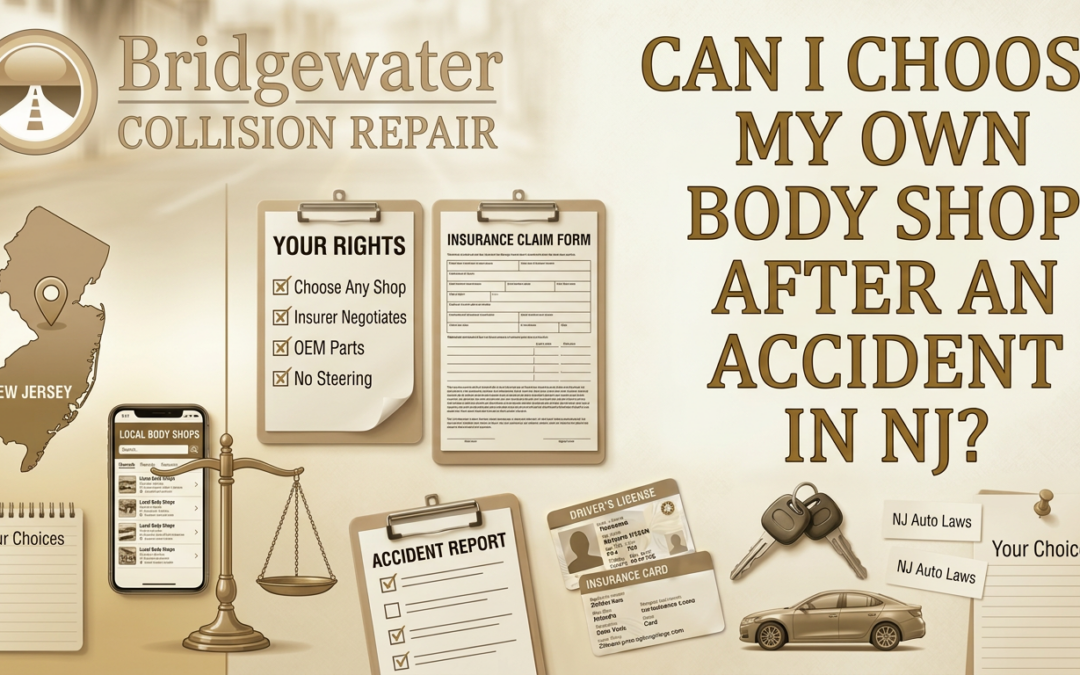
New Jersey law gives you the right to choose your own collision repair shop. This is not a gray area or a matter of insurer policy. It is a consumer protection established in the New Jersey Administrative Code and enforced by the New Jersey Department of Banking and Insurance. Despite this, many drivers are not aware of this right when they file a claim, and some experience pressure to use a shop from their insurer’s approved list.
This article explains what New Jersey law says, what Direct Repair Programs are and how they work, and what your insurer can and cannot do when it comes to directing where your vehicle is repaired.
What Does New Jersey Law Say About Shop Choice?
Under New Jersey Administrative Code (N.J.A.C. 11:3-10), insurers are required to allow policyholders to choose their own repair facility. An insurer may maintain a list of preferred or approved shops and may recommend those shops, but the insurer cannot require you to use one as a condition of receiving coverage for your repairs. If you choose a shop that is not on the insurer’s preferred list, your insurer is still obligated to negotiate and settle the claim with that facility, provided the shop is properly licensed under New Jersey law.
New Jersey also has an Auto Body Repair Consumer Bill of Rights, which repair facilities are required to display. This document outlines consumer protections including the right to choose your shop, the right to a written estimate, and the right to authorize repairs before work begins. The New Jersey Auto Body Repair Consumer Bill of Rights article covers these protections in more detail.
What Is a DRP Shop and Why Does My Insurer Recommend It?
A Direct Repair Program (DRP) is a contractual arrangement between an insurance company and a repair facility. Under a DRP agreement, the shop agrees to certain pricing terms, cycle time targets, and claims processing procedures in exchange for referrals from the insurer. These arrangements benefit insurers by controlling costs and streamlining the claims process. They benefit participating shops by providing a steady volume of referred work.
There is nothing inherently improper about these arrangements, and many DRP shops perform quality repairs. The relevant consideration for a driver is understanding what the relationship means: a DRP shop has a financial agreement with the insurer that includes pricing constraints. An independent shop you choose yourself has no such agreement and is accountable solely to you as the customer. The article Insurance Preferred Shops vs. Your Own Choice explores this comparison in more detail.
Can My Insurer Deny My Claim If I Choose a Different Shop?
No. Under New Jersey law, an insurer cannot deny a valid claim or reduce your settlement solely because you chose a shop outside their preferred network. The insurer must work with the shop you selected to assess and settle the damage, provided the facility is licensed to perform auto body repairs in New Jersey.
Where differences can arise is in the handling of the estimate. An insurer’s preferred shop may operate under a pre-negotiated labor rate, while an independent shop may submit an estimate at a different rate. In those situations, the insurer and the shop are required to negotiate in good faith. If a gap remains, your repair facility should be equipped to document and support the estimate. A shop that follows OEM repair procedures and maintains thorough documentation is better positioned to resolve these differences efficiently.
What Protections Do I Have If an Insurer Pressures Me?
If you believe your insurer is applying improper pressure to use a specific shop, you have options through New Jersey’s regulatory system. The New Jersey Department of Banking and Insurance handles consumer complaints related to insurance claims handling. The NJDCBA operates an Office of the Insurance Ombudsman specifically for resolving disputes between consumers and insurers, including concerns about shop steering.
Keeping records of your communications with your insurer is helpful in these situations. Document any conversations where a specific shop was presented as required rather than recommended, and note whether the option to choose your own facility was disclosed. These records support any complaint you choose to file.
What Should You Look for When Choosing a Shop?
State licensing is the baseline. Beyond that, the factors that distinguish repair facilities in New Jersey are certifications, repair procedures, and documentation practices. OEM certification for your vehicle’s make means the shop is trained and equipped to follow manufacturer repair specifications. This matters particularly for structural repairs, ADAS calibration, and any work on vehicles with aluminum or high-strength steel construction.
Ask whether the shop performs a pre-scan before repairs begin and a post-scan after completion. These diagnostic steps confirm that the vehicle’s electronic systems were functioning properly before work started and that no new concerns were introduced during the repair. Ask whether the shop documents its repair procedures and can provide calibration reports for any sensor work. These are reasonable questions, and a qualified shop will have straightforward answers.
For a broader look at what to evaluate when selecting a facility, How to Choose a Body Shop You Can Trust covers the key considerations.
Schedule an Assessment at Bridgewater Collision Repair
You have the right to choose where your vehicle is repaired, and exercising that right does not require approval from your insurer. Our team works directly with insurance companies and handles the documentation and communication that supports a smooth claim. Contact us to schedule an assessment at either our Bridgewater or Glen Gardner/Clinton location.