
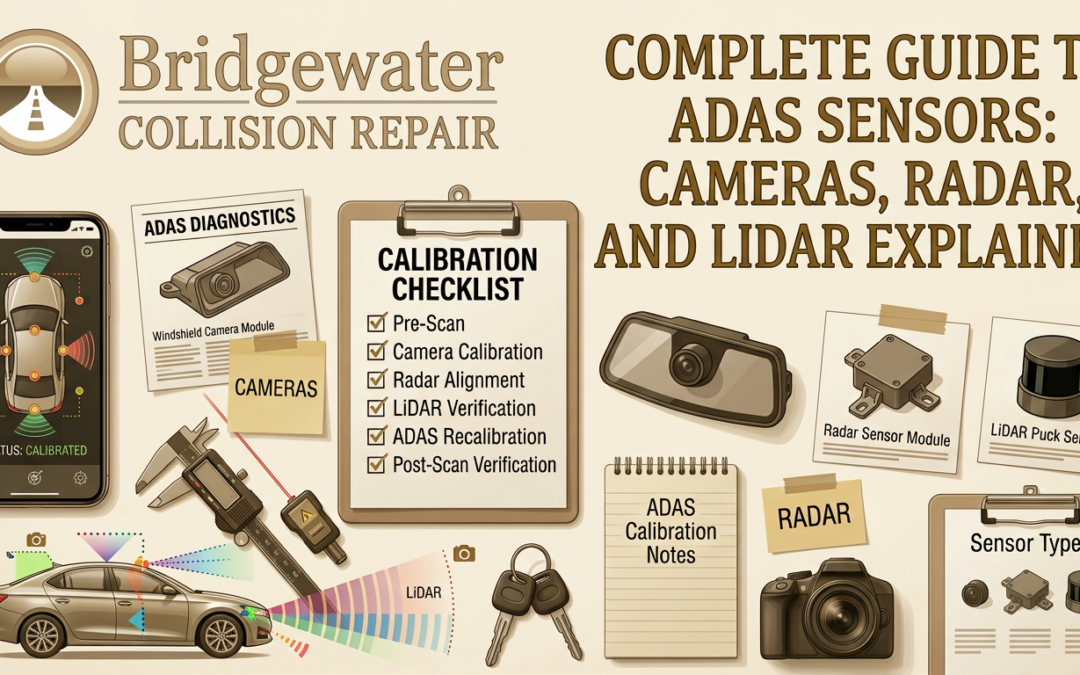
Most drivers interact with Advanced Driver Assistance Systems every day without thinking about them. Lane keep assist, automatic emergency braking, blind spot monitoring, and adaptive cruise control are all ADAS features. They depend on a network of sensors mounted around the vehicle: cameras, radar units, and in some cases LiDAR. These sensors work together to give the vehicle a continuous picture of the road environment. When one is displaced or miscalibrated, the system’s ability to interpret that environment accurately is compromised.
Understanding what these sensors do and why they require careful attention after a collision helps you ask the right questions when choosing a repair facility. This article covers each sensor type, what it does, and what proper recalibration involves.
What Is ADAS and What Does It Do?
Advanced Driver Assistance Systems is the collective term for electronic safety and driver support features that use real-time sensor data to assist vehicle operation. These systems include automatic emergency braking, forward collision warning, rear cross-traffic alert, lane departure warning, lane centering, adaptive cruise control, parking assistance, and traffic sign recognition. The list has grown substantially over the past decade, and many of these features are now standard equipment rather than optional upgrades.
All of these functions depend on sensors that must be precisely aimed and calibrated. A forward-facing camera that monitors lane markings, for example, must be positioned at the exact angle and height specified by the vehicle’s manufacturer. A deviation of a few millimeters in mounting position can translate to meaningful errors in how the system reads the road ahead. This is why ADAS calibration after a collision is not a formality but a functional requirement.
What Do Cameras Do in an ADAS System?
Cameras are among the most widely used ADAS sensors. They are mounted at various points on the vehicle: a forward-facing camera typically mounted near the rearview mirror, rear cameras for backup assistance, side cameras for blind spot monitoring, and surround-view systems that use multiple cameras to create a composite overhead view. Each camera serves a specific function and is calibrated independently.
Forward cameras interpret lane markings, pedestrians, cyclists, traffic signals, and vehicles ahead. They feed data to systems like automatic emergency braking and lane departure warning. Because these interpretations involve visual recognition, the camera’s aim must be precise. Even a minor shift in the mounting bracket, caused by an impact that never touched the camera itself, can change the camera’s field of view enough to affect system accuracy. For more detail on when ADAS calibration is required after repair work, see When Does a Windshield Replacement Require ADAS Calibration.
What Does Radar Do?
Radar sensors emit radio waves and measure the reflection time to calculate the distance and speed of objects around the vehicle. They are commonly used for adaptive cruise control, which maintains a set following distance from the vehicle ahead, and for rear cross-traffic alert, which detects vehicles approaching from the side when you are backing out of a parking space.
Radar sensors are typically embedded in the front grille, behind the front bumper fascia, and at the rear corners of the vehicle. Because they are integrated into body panels and bumper assemblies, a collision that damages these areas may affect sensor aim even when the sensor itself appears undamaged. The reinforcement bar, bumper brackets, and mounting points all affect where the radar unit is oriented, and displacement in any of those components can shift the sensor’s field of coverage. This is one reason a thorough post-collision inspection looks beyond visible surface damage.
What Is LiDAR and Does My Car Have It?
LiDAR, which stands for Light Detection and Ranging, uses laser pulses to build a three-dimensional map of the vehicle’s surroundings. It offers higher resolution spatial data than radar and is effective at identifying the shape and position of objects in the vehicle’s path. LiDAR is currently found primarily in higher-end vehicles and certain electric models, and it plays a significant role in more advanced driver assistance functions.
Where LiDAR is present, the same calibration principles apply as with cameras and radar. The sensor must be aimed correctly and its output validated against manufacturer specifications. As LiDAR becomes more common in mainstream vehicles over the coming years, familiarity with its calibration requirements will be increasingly relevant for collision repair facilities.
Why Does ADAS Calibration Matter After a Collision?
ADAS calibration is the process of verifying and resetting sensor aim and system parameters after work that could have affected their position. There are two types: static calibration, performed in a controlled environment using targets and measurement tools while the vehicle is stationary, and dynamic calibration, performed while driving the vehicle under specified conditions so the system can self-correct based on real-world input.
Which type is required depends on the vehicle’s make, model, and which systems were potentially affected by the repair. Manufacturers publish calibration requirements in their repair documentation, and following those requirements is part of what it means to repair a vehicle to OEM specifications. A shop that repairs collision damage but skips calibration leaves the vehicle with systems that may appear to function normally while operating on inaccurate data. The Why Do ADAS Calibrations Get Missed article explains how this happens and what the consequences can be.
How Do You Know If Your ADAS Was Properly Recalibrated?
The most direct way to confirm that calibration was completed is to ask for the calibration report. A proper calibration process generates documented results showing that the systems were verified against manufacturer targets. This report should include the specific systems calibrated, the method used, and the results. If a shop cannot provide this documentation, the calibration either was not performed or was not completed to a verifiable standard.
A pre-scan performed before repairs begin and a post-scan performed after completion provide additional confirmation that the vehicle’s electronic systems are functioning as expected. These diagnostic scans read data from the vehicle’s onboard modules and can identify stored fault codes that indicate system concerns. For more on what these scans cover and why they matter, see the Why ADAS Calibration Is So Important article.
Schedule an Assessment at Bridgewater Collision Repair
If you have questions about whether your vehicle’s ADAS sensors were affected by a collision, or want to confirm that calibration was properly completed after a previous repair, we can help. Contact us to schedule an assessment at either our Bridgewater or Glen Gardner/Clinton location.