
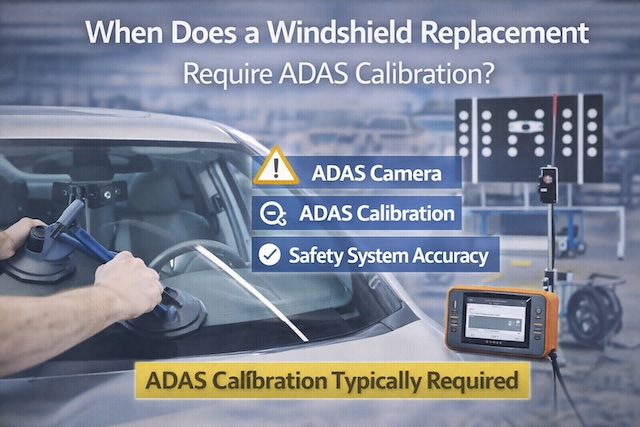
Replacing a cracked or damaged windshield used to be a fairly simple repair. Today, it’s more complex—especially for vehicles equipped with Advanced Driver Assistance Systems (ADAS).
Many modern vehicles rely on cameras mounted to or near the windshield to support safety features like lane-keeping assist, automatic emergency braking, and forward collision warnings. When the windshield is replaced, those systems may need ADAS calibration to work correctly.
This article explains when windshield replacement requires ADAS calibration, why it matters, and what New Jersey drivers should know after glass repairs.
What Is ADAS Calibration?
ADAS calibration is the process of resetting and verifying cameras and sensors so they accurately interpret the road environment.
Windshield-mounted cameras must be positioned with extreme precision. Even slight changes in angle, height, or distance can affect how these systems perform.
Calibration typically falls into two categories:
- Static calibration – performed in a controlled shop environment using targets and measurements
- Dynamic calibration – performed while driving under specific conditions
Some vehicles require one method, while others require both.
Why Windshield Replacement Can Affect ADAS
During windshield replacement:
- Cameras may be removed and reinstalled
- Mounting brackets may shift slightly
- Glass thickness or curvature may differ
- Adhesive curing can affect camera position
Even when the new windshield fits perfectly, these small changes can be enough to require calibration.
Situations Where ADAS Calibration Is Typically Required
While requirements vary by manufacturer, calibration is often needed when:
- The windshield contains a forward-facing camera
- The camera or mounting bracket is removed or disturbed
- The vehicle manufacturer specifies calibration after glass replacement
- ADAS warning lights appear after replacement
- A diagnostic scan indicates calibration is required
Some vehicles may not show warning lights even if calibration is needed, which is why following manufacturer procedures is important.
What Happens If Calibration Is Skipped?
If ADAS calibration is missed after windshield replacement, safety systems may:
- Respond too late—or too early
- Fail to recognize vehicles or pedestrians
- Trigger false alerts
- Operate inconsistently
Organizations like the National Highway Traffic Safety Administration emphasize that driver assistance systems must function correctly to support crash prevention:
https://www.nhtsa.gov/road-safety/driver-assistance-technologies
Manufacturer Requirements Matter
Each vehicle manufacturer sets its own repair requirements. Some specify calibration:
- After any windshield replacement
- Only if the camera is removed
- Only when certain tolerances are exceeded
This is why the answer to “Does my windshield replacement require ADAS calibration?” is often vehicle-specific.
ADAS and Insurance Considerations
ADAS calibration is not an optional add-on—it’s part of restoring the vehicle’s safety systems.
In many cases:
- Calibration is considered a necessary repair step
- Documentation may be required to show it was completed
- Skipping calibration can create issues if future claims arise
For general consumer guidance on auto insurance and repairs, the New Jersey Department of Banking and Insurance offers helpful resources:
https://www.nj.gov/dobi/
What This Means for New Jersey Drivers
After a windshield replacement, it’s reasonable to ask:
- Does my vehicle have ADAS features tied to the windshield?
- Did the manufacturer require calibration?
- Was calibration performed and documented?
- Were diagnostic scans completed before and after?
Clear answers help ensure your vehicle’s safety systems are functioning as designed.
Helpful External Resources
These authoritative sources provide additional context and reinforce the information above:
- National Highway Traffic Safety Administration – Driver assistance technologies and safety
https://www.nhtsa.gov/road-safety/driver-assistance-technologies - Insurance Institute for Highway Safety – ADAS performance and crash prevention research
https://www.iihs.org/topics/advanced-driver-assistance - Consumer Reports – Understanding ADAS features and limitations
https://www.consumerreports.org/cars/car-safety/ - Automotive Service Association – Industry guidance on modern vehicle repairs
https://asashop.org
Final Thoughts
Windshield replacement isn’t just about visibility anymore—it can directly affect the safety systems designed to help prevent accidents.
Understanding when windshield replacement requires ADAS calibration helps you ask the right questions and avoid assumptions. If you’re unsure whether calibration applies to your vehicle, a qualified collision repair professional can review manufacturer requirements and explain what steps are necessary—so you can drive away with confidence that your safety systems are ready when you need them.