
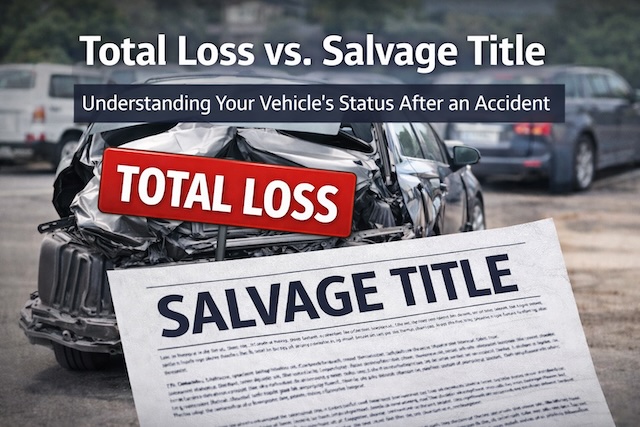
What Happens If My Car Is Deemed a Total Loss?
Discovering that your car has been declared a total loss can feel like a second accident. You may wonder why the car can’t be fixed, how your insurer decided on the payout and what happens if you decide to keep the vehicle. Understanding the difference between a total loss and a salvage title empowers you to make informed decisions.
What is a total loss?
An insurance company declares a vehicle a total loss when it is “economically impractical to repair”nj.gov. In practice, insurers often total a car when the cost of repairs is about 80 % of its actual cash value (ACV)nj.gov. This is because hidden damage discovered during repairs could push the cost beyond the vehicle’s value. Once a total loss is declared, your insurer will pay you the ACV minus your deductible and then typically take ownership of the vehiclenj.gov.
How insurers value your vehicle
New Jersey regulations require insurers to use one of three methods to determine a total loss valuenj.gov:
- Average retail value: Taking the average of retail values from current editions of the Automobile Red Book and N.A.D.A. Official Used Car Guidenj.gov.
- Local dealer quote: Obtaining a price from a dealer within 25 miles for a substantially similar vehiclenj.gov.
- Computerized fair‑market valuation: Using a recognized database like Audatex, Mitchell or CCC to calculate the fair market valuenj.gov.
If your vehicle cannot be valued accurately using these methods, the insurer must use the best available approach and explain in writing how the value was determinednj.gov. They must also provide an itemized list of additions, deductions and applicable sales taxnj.gov.
What happens to your car after it’s totaled?
When a settlement is reached, the insurer usually takes possession of your vehicle and issues a salvage title. Under New Jersey law, a salvage vehicle is one that has been wrecked or damaged to the extent that the insurance company deems it uneconomical to repairnj.gov. All salvage vehicles must be titled in the state, and the title will bear the word “salvage” across itnj.gov. The insurer may sell the vehicle to a salvage yard to recoup part of the payout.
Keeping a totaled car: salvage and rebuilt titles
You may be allowed to keep your vehicle even after it is declared a total loss. If the insurer agrees, they will deduct the salvage value from your settlementnj.gov. For vehicles less than eight years old, New Jersey requires you to obtain a salvage certificate before repairing or retitling the carnj.gov. To request a salvage title, you must submit:
- The New Jersey title assigned to the insurance company with a sales‑tax‑satisfied stamp.
- A $60 title fee and any applicable penaltynj.gov.
- An insurance listing sheet (Form BA‑28) showing the vehicle’s ACV, type of loss, damage estimate and other detailsnj.gov.
After repairs, the vehicle must pass a special inspection by the Motor Vehicle Commission before it can be driven on public roadsnj.gov. If it passes, you may obtain a reconstructed title, sometimes called a “rebuilt” title. Keep in mind that vehicles with salvage or rebuilt titles often have lower resale value and may be harder to insure.
Pros and cons of keeping your totaled vehicle
- Pros:
- Opportunity to repair and continue using a vehicle you know well.
- Potential to save money if you can perform some repairs yourself or find parts at a discount.
- Cons:
- The salvage value deduction reduces your insurance payout.
- You must pay for repairs out of pocket and navigate the salvage inspection process.
- A salvage or rebuilt title may limit your ability to obtain full coverage insurance and will reduce resale value.
What this means for you
- If your vehicle is totaled, ask your insurer which valuation method they used and request the itemized calculationnj.gov.
- Consider whether keeping the car makes financial sense. Factor in repair costs, salvage inspection fees and future insurance premiums.
- If you decide to keep the car, obtain a salvage certificate and schedule an inspection. Without a successful inspection, you cannot legally drive the vehiclenj.gov.
- Understand that a rebuilt title will appear on the vehicle’s record permanently, affecting resale and trade‑in value.
A final word
Receiving a total‑loss determination can be upsetting, but understanding how insurers calculate value and what happens to your vehicle can ease the transition. Whether you accept the payout and let your insurer take the car or decide to keep and rebuild it, know your options and obligations. Bridgewater Collision & Repair can explain the repair process, estimate costs and help you decide if restoring a totaled car is worthwhile. If you have questions about total‑loss settlements or salvage titles, a knowledgeable collision repair professional can guide you.
Article 5 – Subrogation and Your Deductible: Getting Reimbursed After Your Insurance Pays
After a collision, you might pay your deductible and let your own insurance company handle the repairs, even if the other driver is at fault. But what happens next? In many cases, your insurer will pursue reimbursement from the at‑fault party’s insurer through a process called subrogation. This article explains what subrogation is, when it applies and how it affects your deductible.
What is subrogation?
Subrogation is a legal process that allows your insurer to step into your shoes to recover money paid on your behalf from the at‑fault driver’s insurance company. When you file a claim under your collision coverage, your insurer pays for the repairs (minus your deductible) and then seeks to recoup that amount from the responsible party. According to the Epstein Law Firm, this process reduces insurer losses and may directly benefit you if your deductible is refunded as part of the recoverytheepsteinlawfirm.com.
When does subrogation apply?
Subrogation typically applies when another party is clearly or primarily at faulttheepsteinlawfirm.com. Common scenarios include rear‑end collisions, crashes involving uninsured drivers, or property damage caused by third‑party negligencetheepsteinlawfirm.com. New Jersey’s modified comparative negligence rule allows your insurer to recover damages from the other party if you are less than 50 % at faulttheepsteinlawfirm.com. If you are 50 % or more responsible, neither you nor your insurer can recover from the other driver.
How the subrogation process works
- Claim payment: Your insurer pays for repairs and other covered damages, subtracting your deductible.
- Fault evaluation: The insurer reviews the accident details to determine whether another party is liabletheepsteinlawfirm.com.
- Demand and negotiation: If fault is clear, your insurer files a demand with the at‑fault driver’s insurer. If the other insurer agrees, funds are recoveredtheepsteinlawfirm.com.
- Arbitration: When insurers dispute liability or the amount owed, they may submit the case to arbitration, a formal yet non‑judicial process where a neutral third party decidestheepsteinlawfirm.com.
During subrogation, you usually do not need to participatetheepsteinlawfirm.com. However, your insurer might ask for a statement, photos or other evidence. Keeping good records from the accident — such as police reports and repair invoices — can help if questions arise.
Your rights during subrogation
- Deductible reimbursement: You are entitled to a refund of your deductible if your insurer recovers that amount from the at‑fault partytheepsteinlawfirm.com. This refund is usually automatic, but it is wise to confirm with your insurer.
- Notification: While not always required, many insurers will notify you when subrogation is initiated or completedtheepsteinlawfirm.com. This transparency allows you to track your refund.
- Fair premium treatment: Subrogation should not affect your premiums if you are not at faulttheepsteinlawfirm.com. In fact, a successful subrogation may help keep your rates from increasing by holding the at‑fault driver accountable.
How long does subrogation take?
Subrogation can take several months. The timeline depends on how quickly liability is established, the other insurer’s cooperation and whether arbitration is necessary. During this period, your deductible remains “tied up.” If your deductible is significant, ask your insurer how long recovery is expected to take and whether they can issue a refund sooner. Some companies refund the deductible once they receive partial payment from the at‑fault insurer; others wait until the full amount is recovered.
What this means for you
- If you file a claim with your own insurance and pay a deductible, you may get that money back through subrogation if the other driver is at faulttheepsteinlawfirm.com.
- Keep records of the accident and repairs; you may need to provide evidence during the subrogation process.
- Follow up with your insurer periodically to check the status of your deductible reimbursement. Ask when you can expect the refund.
- Remember that subrogation does not usually affect your premiumstheepsteinlawfirm.com. If you were not at fault, your rates should remain stable.
A final word
Subrogation happens behind the scenes, but understanding it can save you money and reduce frustration. By paying your collision deductible upfront and letting your insurer handle the claim, you benefit from faster repairs. And if the other driver is at fault, you should eventually receive your deductible back. Bridgewater Collision & Repair works closely with insurers — both through DRP relationships and independently — to ensure accurate documentation and facilitate efficient subrogation. If you have questions about deductible recovery or the subrogation process, a knowledgeable collision repair professional or insurance representative can provide guidance.