
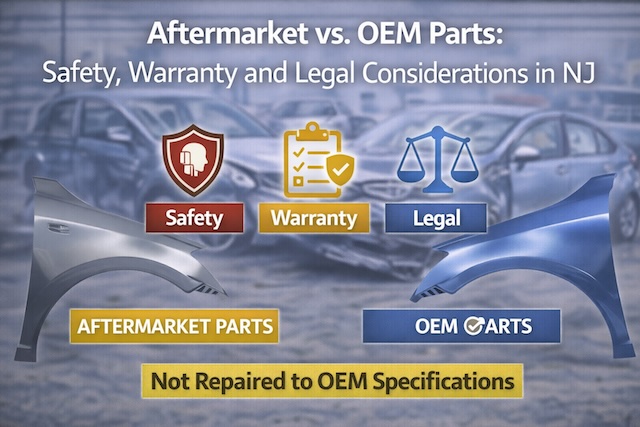
After a collision, one of the most common—and confusing—questions vehicle owners face is whether their car will be repaired with OEM (Original Equipment Manufacturer) parts or aftermarket parts. The choice can affect safety, warranty coverage, and even long-term value.
For New Jersey drivers, understanding the differences—and your rights—can help you make informed decisions without guesswork.
What Are OEM Parts?
OEM parts are made by or for the vehicle manufacturer and are designed specifically for your make and model.
They are engineered to:
- Match original fit and finish
- Perform as designed in a crash
- Integrate correctly with safety systems
- Meet manufacturer specifications and tolerances
Because they are identical to the parts installed when the vehicle was built, OEM parts are often used as the benchmark for repairs.
What Are Aftermarket Parts?
Aftermarket parts are produced by third-party manufacturers, not the vehicle maker.
They can vary widely in:
- Materials
- Fit and finish
- Design tolerances
- Quality control
Some aftermarket parts may perform adequately, while others may require modifications to fit or may not interact with the vehicle exactly as intended.
Safety Considerations: Why Part Choice Matters
Modern vehicles rely on precise engineering. Components like bumper systems, crumple zones, and sensor mounts are designed to work together during a collision.
Potential safety considerations include:
- Variations in thickness or strength
- Differences in energy absorption
- Alignment issues affecting ADAS sensors
- Changes in how airbags deploy or how forces are managed
Independent safety research organizations like the Insurance Institute for Highway Safety highlight how vehicle design and materials affect crash performance:
https://www.iihs.org
Warranty Implications to Understand
A common concern is whether aftermarket parts affect warranties.
Manufacturer Warranty
- Vehicle manufacturers generally cannot void an entire warranty solely because an aftermarket part was used.
- However, if a non-OEM part causes a failure, the manufacturer may deny coverage for that specific issue.
Repair and Parts Warranties
- OEM parts often come with manufacturer-backed warranties.
- Aftermarket part warranties vary by supplier and may differ in scope or duration.
Understanding which warranty applies—and to what—helps avoid surprises later.
For general consumer guidance on warranties, Consumer Reports offers helpful explanations:
https://www.consumerreports.org/cars/car-maintenance/
Legal Considerations in New Jersey
New Jersey law allows the use of aftermarket parts under certain conditions, but it also emphasizes transparency and disclosure.
Key points NJ drivers should know:
- Estimates should clearly identify the type of parts being used
- Consumers have the right to review and approve repair estimates
- You may ask questions or request clarification about part choices
For official guidance, the New Jersey Department of Banking and Insurance provides consumer resources related to auto claims and repairs:
https://www.nj.gov/dobi/
Fit, Finish, and Long-Term Value
Even when safety isn’t immediately affected, part choice can influence:
- Panel alignment
- Paint match
- Noise or vibration
- Corrosion resistance
- Resale or trade-in value
Buyers and dealers often ask whether OEM parts were used during repairs, especially on newer vehicles.
Questions to Ask After an Accident
You don’t need to be an expert—but asking a few questions can clarify your options:
- What type of parts are included in the estimate?
- Are OEM parts available for my vehicle?
- How does part choice affect safety systems?
- What warranties apply to the parts used?
Clear answers help you make a decision that fits your priorities.
Helpful External Resources
These authoritative sources add credibility and context without competing with collision repair services:
- New Jersey Department of Banking and Insurance – Insurance and consumer protection guidance
https://www.nj.gov/dobi/ - Insurance Institute for Highway Safety – Crash safety and vehicle design research
https://www.iihs.org - Consumer Reports – Parts, warranties, and vehicle ownership guidance
https://www.consumerreports.org/cars/ - National Highway Traffic Safety Administration – Vehicle safety systems and standards
https://www.nhtsa.gov/road-safety
Final Thoughts
The choice between aftermarket and OEM parts isn’t just about cost—it’s about understanding how repairs affect safety, warranties, and long-term confidence in your vehicle.
If you have questions about part options or how they apply to your specific repair in New Jersey, a qualified collision repair professional can help explain the differences—so you can move forward with clarity and peace of mind.