
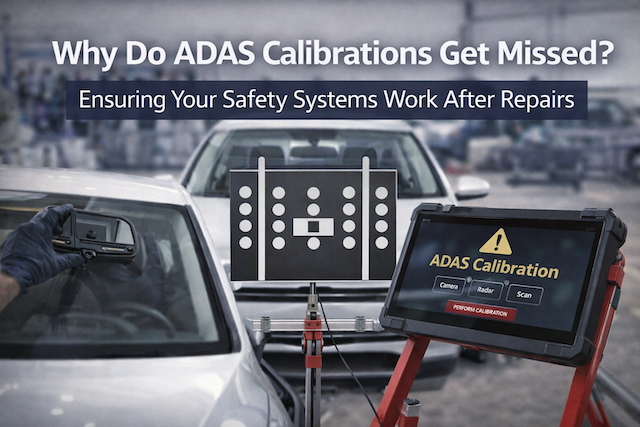
Ensuring Your Safety Systems Work After Repairs
Modern vehicles are designed to help prevent accidents—not just protect you when one happens. Systems like automatic emergency braking, lane-keeping assist, blind-spot monitoring, and adaptive cruise control all rely on Advanced Driver Assistance Systems (ADAS).
Yet after a collision repair, ADAS calibrations are one of the most commonly missed or misunderstood steps in the repair process.
This article explains why ADAS calibrations get missed, why they matter for your safety, and what vehicle owners in New Jersey should know after repairs are completed.
What Is ADAS Calibration?
ADAS calibration is the process of resetting and verifying the cameras, radar units, and sensors that support your vehicle’s safety systems.
These systems depend on extremely precise alignment. Even small changes—often invisible to the eye—can cause them to function incorrectly.
Calibration may be required after:
- A collision (even a minor one)
- Bumper or grille replacement
- Windshield replacement
- Suspension or alignment work
- Structural or frame repairs
- Wheel or ride-height changes
There are two common types:
- Static calibration (performed in a controlled shop environment)
- Dynamic calibration (performed while the vehicle is driven under specific conditions)
Some vehicles require both.
Why ADAS Calibrations Get Missed
ADAS calibrations are rarely skipped on purpose. More often, they fall through the cracks due to misunderstanding, assumptions, or process gaps.
Here are the most common reasons.
1. The Damage Doesn’t Look “Severe Enough”
One of the biggest misconceptions is that ADAS calibration is only needed after major accidents.
In reality, minor collisions often affect ADAS components:
- A bumper cover can flex just enough to move a radar sensor
- A camera mount can shift slightly without cracking
- Ride height changes can throw off sensor angles
Because the damage may appear cosmetic, calibration is sometimes overlooked—even though the safety systems rely on precise measurements.
2. Sensors Are Reused, So Calibration Is Assumed Unnecessary
Another common assumption is:
“Nothing was replaced, so calibration isn’t needed.”
In truth, movement alone can require calibration. Removing and reinstalling parts, loosening fasteners, or adjusting panels can all change sensor positioning—even if the original component is reused.
Manufacturers often specify calibration anytime certain parts are removed or disturbed, regardless of whether they are replaced.
3. Warning Lights Don’t Always Appear
Drivers often expect a dashboard warning if something is wrong.
Unfortunately, many ADAS systems can:
- Be out of calibration
- Still appear to function
- Show no warning lights
That means a system may activate too late, too early, or inconsistently—without alerting the driver that anything is wrong.
4. ADAS Requirements Vary by Vehicle
ADAS is not a one-size-fits-all system.
Different vehicles—and even different trim levels—can have:
- Different sensor locations
- Different calibration triggers
- Different calibration procedures
Without access to manufacturer repair procedures, it’s easy to miss a required step.
5. Calibration Is Sometimes Viewed as Optional
Because calibration adds time and cost, it can be mistakenly treated as an optional step rather than a required safety procedure.
However, ADAS calibration is not an “extra.”
It’s part of restoring the vehicle to its pre-loss safety condition.
Skipping it doesn’t just affect convenience—it affects how your car responds in emergency situations.
Why ADAS Calibration Matters to You
When ADAS systems aren’t properly calibrated, they may:
- Brake too late—or unnecessarily
- Fail to detect vehicles or pedestrians
- Provide false alerts
- Interfere with steering at the wrong time
In other words, the systems designed to help you avoid an accident could increase risk instead of reducing it.
What This Means for Vehicle Owners
After repairs, it’s reasonable—and responsible—to ask a few simple questions:
- Were ADAS calibrations required for my vehicle?
- Which systems were calibrated?
- Was calibration performed according to manufacturer procedures?
- Is there documentation confirming completion?
Clear answers help ensure your vehicle’s safety systems are working as intended.
How to Reduce the Risk of a Missed Calibration
You don’t need to be an expert in vehicle technology—but you can be an informed consumer.
Helpful steps include:
- Choosing a repair facility that follows manufacturer repair procedures
- Asking for documentation of required calibrations
- Understanding that “no warning lights” doesn’t always mean “no issues”
- Confirming calibrations after windshield, bumper, or suspension work
After the Repair: Peace of Mind Matters
ADAS systems are designed to support you when milliseconds matter most. Proper calibration ensures they respond the way engineers intended—not just that they “seem to work.”
If you have questions about ADAS calibrations or how they apply to your specific repair, a qualified collision repair professional can help explain what was required and why.
Understanding the process helps you drive away with more than a repaired vehicle—it helps ensure the safety systems you rely on are truly ready when you need them.
Resources:
NHTSA